
Apr 28, 2026
Smith Names Dale Bahn Vice President of Operations – Data Center Services
Dale will spearhead the company’s multinational operational initiatives for data centers and hype...
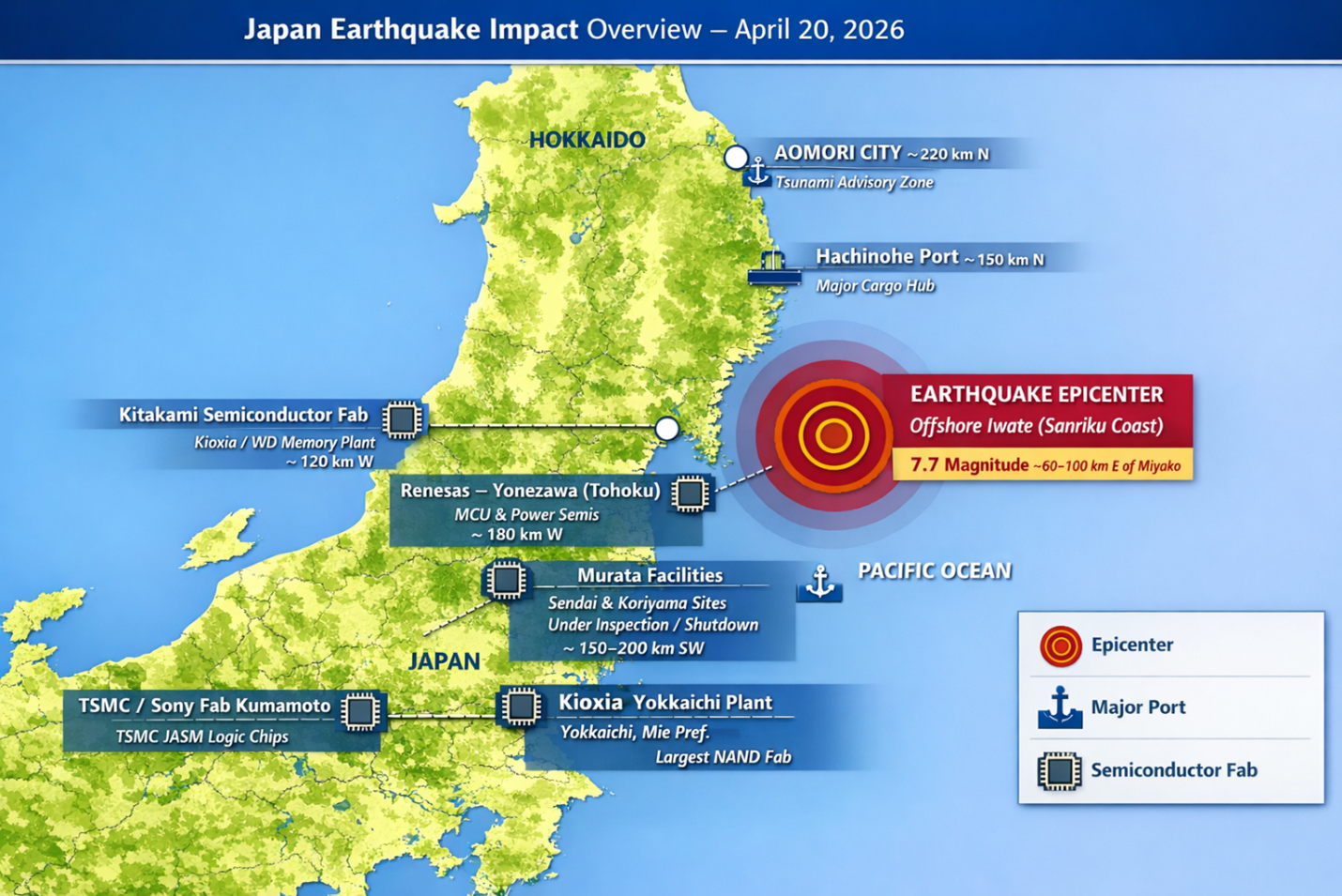
A 7.5-magnitude earthquake occurred off the northwest coast of Japan at 4:53 PM local time on Monday, April 20. Power was lost throughout the Iwate Prefecture, an area where several semiconductor facilities reside, but was quickly restored to residential and industrial buildings.
Fortunately, fewer than a dozen minor injuries were recorded as a result of the earthquake, while several dozen buildings experienced minimal damage. Though tsunami warnings were announced and residents evacuated from coastline areas, the resultant waves were less than a meter high and did not have any major effects.
Details about the impact on the semiconductor industry are still incomplete, but thus far, little has been announced by the companies that were closest to the epicenter, including KIOXIA, Murata, Sony, Renesas, TSMC, SUMCO, Universal Wafer, and Shin-Etsu.
The most disruptive force to wafer growth is shaking, so even after power was restored to the area, some facilities waited to re-establish production in fear of aftershocks. Many, however, resumed production as soon as they were able. Thus far, no reports of major damage at any of these facilities have been reported.
If damage is found later on, a quick overview of possible disruptions can be found below.
KIOXIA
KIOXIA is the fourth-largest NAND producer, manufacturing about 16 percent of total global NAND and 10 percent of SSDs from these facilities.
70-75 percent of KIOXIA’s production is done at its Yokkaichi plant, which was well away from the quake and not at risk. The remaining 25-30 percent is done at its K1 and K2 facilities in Kitakami, including most of KIOXIA’s advanced and densely layered NAND, which is used in enterprise applications. The two facilities are the closest of all Japanese fabs to the oceanic epicenter at 100km away. Here, the earthquake registered a magnitude of 4.0-5.0.
K1 and K2 suffered some power loss, and production lines were shut down. KIOXIA did announce that the buildings sustained no damage at the two facilities, and that both are continuing production activities as usual. It did not say if the company lost any wafers. It will take approximately one week for KIOXIA to return to the production rates it was maintaining at the time of the earthquake.
This loss will be mainly felt during 2Q26; however, any losses could be mitigated if KIOXIA pushes production rates above the previous levels. If so, it will only make some deliveries late but not cause defaults.
Renesas
Renesas is about 120 miles (200km) from the epicenter. No reports of damage or significant disruption have been made.
Murata
Murata had several facilities that lost power, which has since been restored. Thus far, no details about production losses during the power loss have been reported. No reports of equipment damages have surfaced either, and no ports were damaged significantly to disturb normal logistics.
Others
Universal Wafer and SUMCO make general-use, mature-technology silicon wafers. Both companies resumed operations quickly. Shin-Etsu is a manufacturer of some raw materials used in wafer production and final packaging. Most importantly, it makes photoresists that are used in the manufacturing of advanced-logic products, such as GPUs, HBM, and CPUs, that are in high demand across the industry. Luckily, the company has also come out unscathed by the incident.
Another company within the industry supply chain which could have been affected is Tokyo Electron. Like the others, it has not reported any damages and restarted production as soon as inspections were completed.
Japan and Taiwanese facilities are built to withstand earthquakes, especially things that hit off the coast. Nevertheless, power outages always mean loss of some wafers or, in Murata’s case, caps.
Normally, this is only for the products undergoing the “growth” or final packaging at the time of the power loss. Works-in-progress and raw-material storage can have problems, but these are infrequent.
A return of power quickly mitigates the capacity losses but cannot help anything damaged during the loss. Depending on the size of the facility, inspections could last up to two or three days for something like this. Most facilities will complete their inspections, and if the equipment is fine, the companies will immediately put it into motion as long as downstream equipment is ready as well. This was the main occurrence throughout the noted manufacturers.
Smith’s team of experts brings a diverse wealth of knowledge and experience that helps us offer the most relevant and actionable insights into the global electronic-component marketplace. As disruptions continue to affect the semiconductor industry, follow Smith’s Market Blog to stay up to date on the latest information.
We will continue to monitor the situation and share the latest updates as they become available.
Smith Names Dale Bahn Vice President of Operations – Data Center Services
Dale will spearhead the company’s multinational operational initiatives for data centers and hype...
Smith’s Houston Team Builds Tables With the Houston ToolBank
Last month, more than two dozen Smith employees rolled up their sleeves to help build picnic tabl...
Japan Earthquake Update: April 24, 2026
A 7.5-magnitude earthquake occurred off the northwest coast of Japan at 4:53 PM local time on Mon...
您可通过以下三种方式,轻松关注Smith微信公众号: